
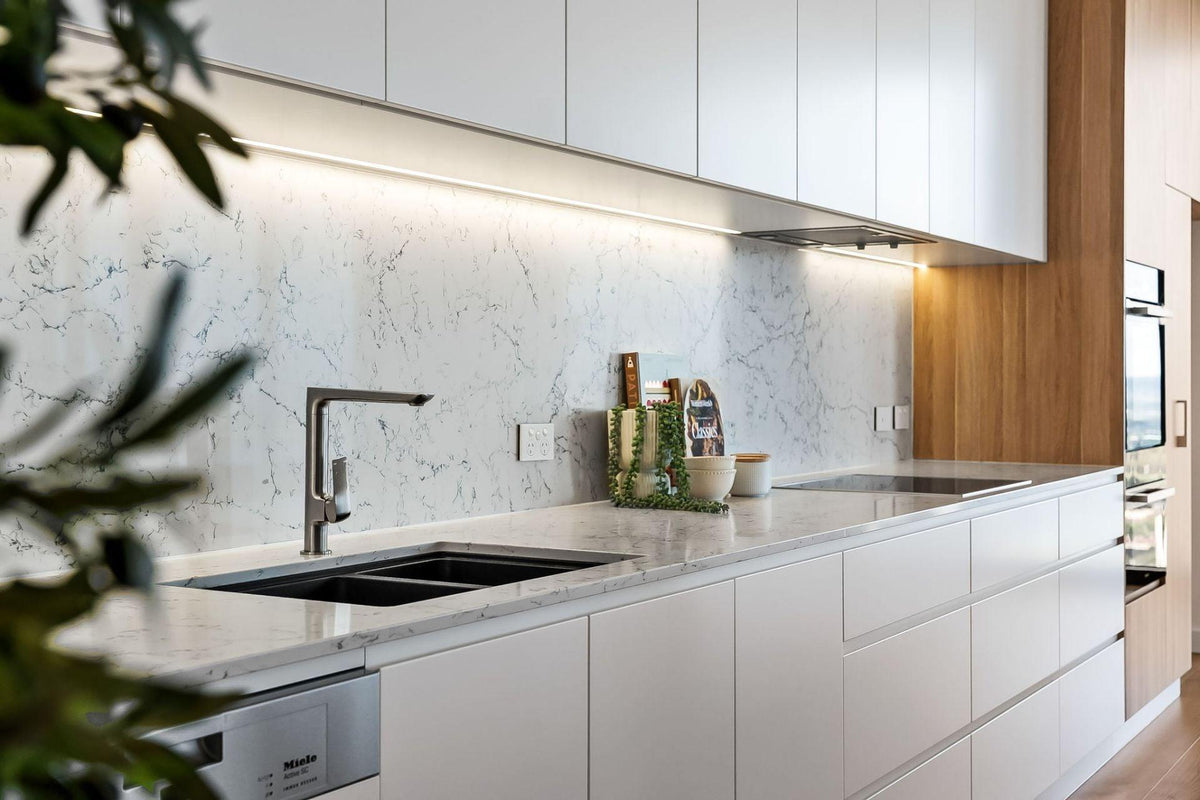
LED strip lights are a popular choice for kitchen cabinets, shelves, bedrooms, display cases and architectural accent lighting. But when comparing different LED strips, one specification often raises questions: should you choose 12V or 24V?
Both are commonly used for low-voltage LED lighting, and neither is automatically better for every installation.
The main differences involve operating current, voltage drop, power supply compatibility and the design of the LED strip itself.
In this guide, we'll explain how 12V and 24V LED strip lights work, compare their advantages and help you choose the right voltage for your project.
What Is the Difference Between 12V and 24V LED Strip Lights?
The main difference is the DC voltage required to operate the strip.
A 12V LED strip is designed for a compatible 12V DC power source, while a 24V LED strip requires 24V DC.
For the same total wattage, a 24V system draws approximately half the current of a 12V system.
This matters because electrical current affects voltage drop and wiring requirements.
However, operating voltage alone does not determine brightness, efficiency, LED quality or color accuracy. Those characteristics depend on the specific strip design.
12V vs 24V LED Strips: Quick Comparison
| Feature | 12V LED Strip | 24V LED Strip |
|---|---|---|
| Required power supply | 12V DC | 24V DC |
| Current at equal wattage | Higher | Lower |
| Voltage drop over comparable wiring | Generally greater | Generally lower |
| Longer cable runs | May require more attention to voltage drop | Often easier to manage |
| Cutting intervals | Product-dependent | Product-dependent |
| Brightness | Depends on model | Depends on model |
| Power efficiency | Depends on model | Depends on model |
| Best choice | Based on system requirements | Based on system requirements |
A 24V strip is often advantageous for longer installations, but a well-designed 12V system can perform equally well when correctly powered and installed.
Why Does Voltage Affect Current?
Electrical power is calculated using the formula:
Power (W) = Voltage (V) × Current (A)
Rearranging the formula:
Current (A) = Power (W) ÷ Voltage (V)
Consider two LED strips with the same total power consumption of 48W.
12V System
48W ÷ 12V = 4A
24V System
48W ÷ 24V = 2A
Both systems consume 48W, but the 24V system draws half the current.
Lower current can reduce resistive losses in the wiring and help simplify power distribution for some installations.
Understanding Voltage Drop in LED Strip Lighting
Voltage drop occurs when electrical current passes through wires and conductive traces that have resistance.
As current flows, some voltage is lost along the electrical path.
In LED strip installations, excessive voltage drop can cause:
- Reduced brightness toward the far end
- Uneven lighting along a strip
- Color differences in some multicolor systems
- Inconsistent performance
For a basic DC cable circuit, voltage drop can be estimated using:
Voltage Drop = Current × Circuit Resistance
When the same cable is used with an equal-wattage load, the 24V system draws less current and therefore generally experiences less voltage drop.
However, the LED strip's internal copper traces also contribute to voltage drop. Two strips with different PCB designs may behave differently even when they have the same rated voltage.
Example: Comparing Voltage Drop in a 5-Meter Power Cable
Suppose a 48W LED lighting load is connected through a 5-meter, two-conductor copper cable.
For illustration, assume each conductor has a resistance of approximately 0.021 ohms per meter, corresponding roughly to 18 AWG copper at 20°C.
The current travels through both the positive and negative conductors.
Total circuit resistance:
5m × 2 × 0.021Ω/m = 0.21Ω
For the 12V system:
4A × 0.21Ω = 0.84V
For the 24V system:
2A × 0.21Ω = 0.42V
| Measurement | 12V System | 24V System |
|---|---|---|
| Total load | 48W | 48W |
| Current | 4A | 2A |
| Cable resistance | 0.21Ω | 0.21Ω |
| Estimated voltage drop | 0.84V | 0.42V |
| Percentage of nominal voltage | 7% | 1.75% |
This simplified example shows why 24V systems can be useful for longer cable runs.
The calculations cover the external power cable only. They do not include LED strip PCB resistance, connectors, temperature changes or variations in operating current.
When Should You Choose 12V LED Strip Lights?
A 12V LED strip may be a practical choice when the installation already uses a compatible 12V power system.
Common applications include:
- Small cabinet lighting projects
- Short decorative lighting runs
- Display shelves
- Compact furniture lighting
- Compatible 12V lighting systems
12V can also be convenient when a specific strip offers cutting intervals that better suit a small installation.
However, cutting intervals vary by product. Always check the marked cut points rather than assuming all 12V strips can be cut into shorter sections than 24V strips.
When Should You Choose 24V LED Strip Lights?
24V LED strips are often worth considering for installations that require longer cable runs or higher total wattage.
Because a 24V system uses less current for the same power, it may be easier to manage voltage drop.
Typical applications include:
- Long under-cabinet lighting runs
- Ceiling cove lighting
- Extended shelving
- Architectural accent lighting
- Larger decorative lighting projects
However, 24V does not mean unlimited strip length.
Every LED strip has its own recommended maximum continuous run, and longer installations may still require additional power injection points.
Are 24V LED Strips Brighter Than 12V?
Not necessarily.
A 24V LED strip is not automatically brighter than a 12V LED strip.
Brightness depends on factors such as:
- LED type
- LED density
- Power consumption per meter
- LED efficiency
- PCB design
- Optical design
- Operating conditions
For example, a 12V strip with higher power consumption and efficient LEDs may produce more light than a lower-powered 24V strip.
When comparing brightness, check the product's lumen output per meter where available.
LED density can influence how continuous the light appears, but a higher LED count does not automatically guarantee higher total brightness.
Does 24V Use Less Electricity Than 12V?
Not automatically.
If a 12V strip and a 24V strip each consume 48W, their nominal LED load power is the same.
The 24V system draws less current, which may reduce wiring losses in a comparable circuit.
However, total electricity consumption also depends on the efficiency of the power supply and the LED strip.
To compare actual energy use, look at the rated power consumption and relevant efficiency information rather than voltage alone.
How to Choose the Right LED Power Supply
A constant-voltage LED strip requires a compatible constant-voltage DC power supply.
The output voltage must match the strip's rated input.
For a 12V LED strip: Use a suitable 12V DC constant-voltage supply.
For a 24V LED strip: Use a suitable 24V DC constant-voltage supply.
Never connect a 12V-only LED strip directly to a 24V power supply.
To estimate the required power capacity:
Total Wattage = Strip Wattage per Meter × Installed Length
For example, a 24V strip rated at 9.6W/m and installed over 5 meters requires:
9.6W/m × 5m = 48W
Select a power supply with sufficient rated capacity and follow the manufacturer's load and temperature requirements.
The power supply must also be appropriate for the installation environment and compatible with any dimmer or controller used.
Explore the LightingWill LED Switching Power Supply collection for compatible power supply options.
Can You Connect 12V and 24V LED Strips Together?
12V and 24V LED strips should not be connected directly to the same fixed-voltage output.
They require different supply voltages.
If a project includes both voltages, each lighting circuit needs an appropriate power source or properly designed voltage conversion arrangement.
Controllers and other accessories must also support the voltage of the connected strip.
Do not assume that a controller rated for 12V automatically supports 24V.
What About LED Strip Cutting Intervals?
LED strips are designed with marked cutting points.
These indicate where the strip can be separated without damaging the intended circuit arrangement.
Some 12V designs have shorter cutting intervals than comparable 24V designs, but this is not a universal rule.
Cutting intervals depend on LED grouping, circuit design and the particular product.
Before cutting:
- Disconnect the power supply.
- Locate the manufacturer's marked cut points.
- Check the minimum segment length.
- Use the appropriate connector or soldering method.
- Confirm polarity before reconnecting power.
Never cut an LED strip at an unmarked location unless the product documentation explicitly permits it.
How to Reduce Voltage Drop in Longer Installations
Regardless of voltage, proper power distribution is essential.
Several methods can help:
Use Suitable Wire Gauge
Larger conductors generally have lower resistance.
Choose cable based on current, length, installation conditions and applicable electrical requirements.
Shorten the Power Cable
Place the power supply closer to the lighting load where practical and permitted.
Add Power Injection Points
Long LED strips may benefit from additional power connections, according to the manufacturer's design.
Divide the Installation Into Sections
Multiple separately powered sections can sometimes provide more consistent illumination than one excessively long continuous run.
Check Connector Ratings
Connectors must be suitable for the expected current.
For wiring accessories, explore the LightingWill Connectors collection.
12V vs 24V for Different Lighting Applications
| Application | What to Consider |
|---|---|
| Small cabinet | Available cut points, space and existing power supply |
| Long kitchen countertop | Voltage drop, total load and power injection |
| Bedroom accent lighting | Strip design, color temperature and installation length |
| Ceiling cove | Cable routing, continuous run limits and service access |
| Display shelves | Segment length and connector size |
| Larger installation | Current, wiring losses and power distribution |
For short installations, either voltage may work well when the components are compatible.
For longer or higher-power installations, 24V is often a practical starting point, but the final choice should follow the exact product specifications.
Common Mistakes When Choosing 12V or 24V LED Strips
Assuming 24V Is Always Brighter
Voltage alone does not determine brightness.
Using the Wrong Power Supply
A voltage mismatch can damage lighting equipment.
Ignoring Voltage Drop
Long cable runs may create noticeable performance problems.
Assuming Every 24V Strip Supports Longer Runs
Maximum continuous length varies by product.
Mixing Incompatible Controllers
Controllers must support the correct voltage and lighting type.
Choosing Based Only on LED Density
LED count does not tell you everything about brightness or power.
Ignoring Cutting Intervals
Always check the marked cut points before planning a short installation.
Final Checklist
Before selecting a 12V or 24V LED strip, confirm:
- What voltage does the project require?
- Is there an existing compatible power supply?
- How long is the LED strip?
- What is the wattage per meter?
- What is the total electrical load?
- How long is the cable between the power supply and strip?
- Is voltage drop likely to be significant?
- Does the strip require additional power injection?
- Are the cutting intervals suitable?
- Are the controller and connectors compatible?
- Is the selected power supply rated for the load?
- Does the installation meet environmental and electrical requirements?
Conclusion
Both 12V and 24V LED strip lights can provide effective illumination when correctly selected and installed.
12V strips may be convenient for compact lighting projects and existing 12V systems. 24V strips often offer advantages for longer runs because they draw less current at the same wattage, helping reduce wiring losses.
However, voltage alone does not determine brightness, efficiency or maximum installation length.
The best choice depends on the specific LED strip, total power consumption, wiring distance, cutting requirements and available power supply.
Explore the LightingWill Flexible LED Strips collection to compare available 12V and 24V LED strip options.


Leave a comment
This site is protected by hCaptcha and the hCaptcha Privacy Policy and Terms of Service apply.